



How to Choose Solder Wire for PCB Repair and Soldering
Author Dmitrii KhramtsovPosted 27 April 2026
Updated 27 April 2026
The wrong solder wire can ruin your entire soldering process, even if the soldering station is good, the flux and soldering iron tip are fine, and the temperature is set correctly. People forget about the quality and characteristics of the solder wire itself. And when you use cheap Chinese solder wire with an unknown composition, the problems become even worse.
Which solder wire is worth buying for soldering and electronics repair, and which solder wire are better to avoid right away?
Lead or Lead-free Solder Alloy?
This topic has already been fully covered in this article - LEAD or LEAD-FREE ALLOY?. I will only remind you that for most printed circuit board repairs, lead alloy solder wire is fine. Lead-free solder wire is only needed when you clearly understand why you are using it and for what specific task. You have set the correct temperature of 350 °С (662 °F), and the soldering iron tip is able to work in this high temperature for a long time.
For comfortable manual soldering and electronics repair, lead solder wire is the most universal. It melts well, behaves more calmly on the tip, and has good flow. But the choice of solder wire does not end with the question of “lead or lead-free.” There are several more factors that affect to soldering quality.
What is important when choosing solder wire?
Solder wire diameter
This is one of the most underestimated parameters. Many people don’t look at the diameter at all. Buy whatever they happen to find. Then they struggle during soldering and think that they have a bad soldering station or crooked hands. In practice, diameter strongly affects how easily the molten solder is fed into the solder joint, the speed of soldering, the filling of plated through holes, the quality of fillets, and the overall pace of work.
For myself, I chose a diameter of 0.8 mm - 20 AWG - 0.032" a long time ago as the most convenient universal diameter for manual soldering. This solder wire is rigid enough to be fed normally by hand, not dangle around, and not bend like a thread. At the same time, it melts quickly, it is enough for normal filling of plated through holes, for soldering of through-hole components and connectors, and it is simply comfortable to work.
Solder wire that is too thin, especially below 0.8 millimeters, is often less convenient in real work. It is consumed quickly, bends easily, and forces you to constantly aim at the solder joint and move it through your fingers more often. For very small tasks, a small diameter of solder wire can be useful, but I would not recommend it as the main.
Dry flux inside the solder wire.
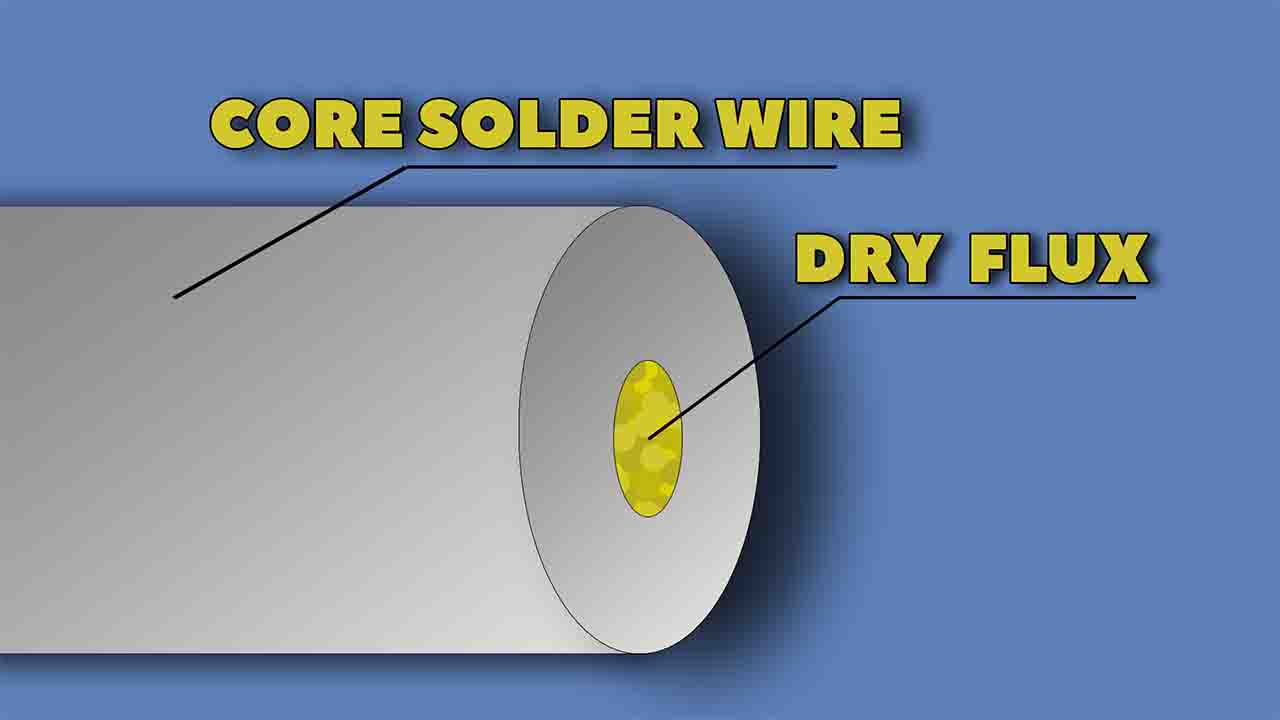
This is a very important point. The presence of ROL0, REL0 or ORL0 class flux inside the solder wire matters a lot when you are soldering a new solder joints, or when you need to fill many plated through holes with component leads. There is no need to add extra flux. In most cases, flux inside the solder wire itself is enough. This speeds up the work and makes the soldering process more convenient. Sometimes the flux inside the wire may not be enough for proper reflow, so you have to add gel or liquid flux, especially for fix first joint.
Don’t forget that the flux inside the solder wire and the flux that you apply additionally should be of the same class. For maximum soldering safety, I use ROL0 class flux, for example gel Diamond Flux FN231 or Liquid Diamond Flux FN232.
It is also sometimes convenient to use solder wire that not contains internal dry flux. In such cases, it is necessary to apply flux beforehand. Otherwise, the molten solder will not flow at all and will simply stick to the surfaces.
Solder wire quality
The quality of the solder alloy inside the wire matters enormously. From the outside, a spool of solder wire may look nice, but in reality, there may be a dirty alloy inside. Most people buy solder spool on well-known marketplaces, where most of the offers are Chinese products. And yes, there are working options among them, but in most cases, you are buying an unclear product with an inaccurate composition, with impurities, and with an unclear flux inside. Then such solder may wet pads, leads, and surface finishes worse, may contaminate the iron tip faster, makes soldering uncomfortable, and the question of what metal proportions are inside will remain a mystery to you.
If your approach is “it soldered, that is enough,” then maybe this will suit you. But if you want to control quality, if you repair or assemble other people’s printed circuit boards, and want to solder at a high level, then the materials must be of high quality.
The manufacturers that I personally trust: BALVER ZINN, KOKI, INDIUM, WELLER, KESTER, AIM.
Which solder wire alloys should not be bought?
First, these are various low-temperature alloys with bismuth or beryllium. Yes, they melt easily and at first glance they are convenient to work with, but low melting temperature by itself does not make the joint high quality. Such alloys are not intended for reliable operation under mechanical load, vibration, and temperature changes. These alloys solder conveniently only until you start thinking about long-term solder joint durability. For printed circuit board assembly and repair, I don’t recommend low-temperature solder alloys at all.
Sometimes, Wood alloy or Rose alloy is used as an additional solder for desoldering, to dilute the existing solder and simplify the removal of some PCB component. In my own practice over many years, I have never used such alloys. It is much more useful to learn how to correctly use a bottom preheating table, hot air temperature, and soldering profiles, than to try to solve everything with low-temperature solder alloys with bismuth or beryllium.
The sellers themselves also make things more difficult for you when under the term “low-temperature solder” they hide both - regular lead solders and actually low-temperature solders. Low-temperature solders are all alloys that reflow below 183 °С (361 °F) and contain metals such as bismuth and beryllium. Tin-lead alloys reflow from 183 °С (361 °F) and, in my opinion, should not be considered low-temperature.
Mistakes when choosing solder wire
- The first mistake is filtering solder wire only by price. Sometimes it seems to you that solder is just a consumable material and that the difference between spools is not that important. This is a mistake. Solder is one of the key materials in the formation of solder joints. If the solder material is bad, then the joint quality will also be bad.
- The second mistake is ignoring the solder wire diameter.
- The third mistake is not trying to understand what flux is inside the solder wire.
- The fourth mistake is buying unknown solder wire from a random manufacturer just because it is cheaper.
- The fifth mistake is overestimating your own skill level and thinking that low-quality materials can be compensated for by execution quality, by experience. No. Bad solder wire will still create extra problems for you.
What solder wire should a beginner buy?
If you are just learning to solder, then at the beginning I would not make a cult out of expensive materials. For training, you can use almost any solder wire of an average level. At this stage, your task is to understand the behavior of molten metal, learn how to hold and control the soldering iron, control heating, solder wire feeding, and the amount of molten solder. While you are building hand skill, there is no sense in immediately chasing the most expensive option. But as soon as you move from training to repairing other people’s printed circuit boards or to soldering new PCBs for customers, the requirements must change sharply. Here you can no longer work by the principle of “I can not do any better.”
Any return due to low soldering quality, any crack, unstable contact, bad joint, or repeated repair is already a direct loss of money and reputation. At that moment, saving money on solder wire becomes simply foolish.
Solder wire alloys formulas.
Lead solder wire alloys for hand soldering:
- Sn63/Pb37
- Sn60/Pb40
- Sn62/Pb3/6Ag2
The color of high-quality lead solder wire is always bright and clean and free of visible spots on the wire.
Lead-free solder wire alloys for hand soldering:
- Sn96.5/Ag3.5
- Sn96.5/Ag3/Cu0.5 (SAC305)
High-quality lead-free solder wire often has a matte surface. This is normal color. Occasionally, small spots of nearly the same color may be visible.
Fume Extraction
And don’t forget to use proper fume extraction during soldering and provide fresh air intake. Do not breathe this!
Conclusion
For manual soldering and electronics repair I would start with lead solder wire from a trusted manufacturer, with a convenient diameter 0.8 mm - 20 AWG - 0.032", and high-quality ROL0, REL0 or ORL0 flux inside. That solder wire is enough to remove a huge number of typical problems and not make the work more difficult for yourself from the very beginning.
If you don’t see markings on the spool when buying, indicating the solder alloy, wire diameter, or flux class, walk away. There are no miracles in soldering. Either you have normal materials and a predictable result, or these are future problems that many people mistakenly blame on the soldering iron, temperature or flux.
Thank you for reading!
Watch video How to Choose Solder Wire